Quotients
Quotient Sets
Let $X$ be a set. An equivalence relation on $X$ is a relation that is reflexive, symmetric, and transitive.
Let $X$ be a set, and let $\sim$ be an equivalence relation on $X$. For any $a \in X$, the set $\bar{a} =\lbrace b \in X | b \sim a \rbrace$ is the equivalence class containing $a$. An equivalence class is a special kind of subset: if two equivalence classes intersect, then they must actually be the same class (by transitivity).
An equivalence relation determines a collection of equivalence classes, called a partition.
For a general map $f:X \rightarrow Y$, let $\sim\_{f}$ be the equivalence relation induced by $f$. It is defined by: $\forall x\_1, x\_2,x\_1 \sim\_{f} x\_2 \Leftrightarrow f(x\_1)=f(x\_2)$. Then for any $x$, its equivalence class is:
Notation: for any $x \in Y$, let $X\_y=f^{-1}(y)$. This kind of $X\_y$ is called the fiber of $f$ over $y$.
Suppose $\sim$ is an equivalence relation on $X$. Define the quotient set of $X$ as:
The relationship between the quotient set and the original set
A quotient set uses an equivalence relation to “compress” the original set, treating equivalent elements as the same. Points that were not originally equal are now regarded as identified. In topology, this is exactly what lets us glue spaces together.
Natural projection: Let $X$ be a set, and let $\sim$ be an equivalence relation on it. The map $\pi: X \rightarrow X / \sim:x \rightarrow \bar{x}$ is called the natural projection. It sends an element of $X$ to its corresponding equivalence class. Clearly, the natural projection is surjective.
In fact, every surjection is a natural projection. More precisely: suppose $f:X \rightarrow Y$ is a surjection. Consider the quotient set $X/\sim\_f$, and let $\pi: X \rightarrow X / \sim\_f$ be the natural projection. Then there exists a unique bijection $\phi: Y \rightarrow X/\sim\_f$ such that the following diagram commutes:
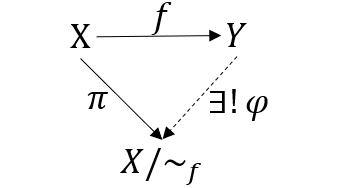
In fact, by the commutative diagram condition, $\phi(y)$ can only be equal to $\pi (x)$.
Since $\phi$ is a one-to-one correspondence, $Y$ is essentially the same as $X/\sim\_f$. This is what it means to say that every surjection is a natural projection. Given any $f$, we can construct $X/\sim\_f$, and this $X/\sim\_f$ is in bijection with $Y$.
Quotient Spaces
Let $X$ be a topological space, let $\sim$ be an equivalence relation, let $\bar{X}=X / \sim$ be the set of equivalence classes produced by this relation, and let $\pi:X \rightarrow \bar{X}$ be the natural projection. Define the topology on $\bar{X}$ as follows: a set is open if and only if its preimage under $\pi$ is open. This topology is called the quotient topology. Under this topology, $\bar{X}$ becomes a topological space, called a quotient space. By the way this topology is constructed, $\pi$ is obviously continuous, and this map is also called a quotient map.
This quotient topology is a pretty blunt definition. Really, it is just there to make the quotient map continuous.
Let $X$ and $Y$ be two topological spaces, and let $\phi$ be a map from $X$ to $Y$. We call $\phi$ an embedding if $\phi : X \rightarrow \phi(X)$ is a homeomorphism, where the image is given the subspace topology.
Remark: The quotient topology is the largest topology that makes the quotient map continuous.
Gluing map: Let $X$ and $Y$ be topological spaces, and let $f$ map $X$ to $Y$. We call $f$ a gluing map if:
- $f$ is a continuous surjection.
- $\forall U \subset Y$, $f^{-1}(U)$ is open $\Leftrightarrow U$ is open in $Y$.
For example, in the construction of the Mobius strip below, the map $\phi$ is a gluing map.
Proposition: Let $X$ and $Y$ be topological spaces, and let $\phi$ be a gluing map from $X$ to $Y$. Then there exists an equivalence relation $\sim$ on $X$, and a unique homeomorphism $g:Y \rightarrow X / \sim$, such that the following diagram commutes:
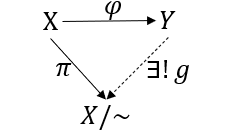
What this proposition says is that even if the map $\phi$ is not very transparent at first, after changing the viewpoint, it is essentially a quotient map. In other words, gluing maps are essentially quotient maps, which is the same kind of idea as surjections are natural projections above.
Three important conclusions:
Proposition 1: Let $\phi$ be a continuous surjection from $X$ to $Y$. If $\phi$ is an open map (or a closed map), then $\phi$ is a gluing map.
Proposition 2: Let $X$ be a compact topological space, let $Y$ be a Hausdorff space, and let $\phi$ be a continuous surjection from $X$ to $Y$. Then $\phi$ is a gluing map.
Proposition 3: Let $X$ be a compact topological space, let $Y$ be a Hausdorff space, and let $\phi$ be a continuous injection from $X$ to $Y$. Then $\phi$ is an embedding.
Mobius Strip
This example constructs a Mobius strip and gives it a topology.
Method one: the intuitive method
This method uses $R^3$, and $M$ will be a subset of $R^3$.
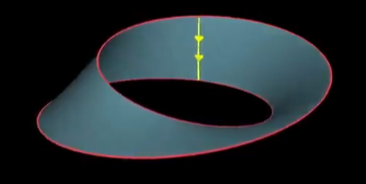
Take a line segment $AB$ whose midpoint lies on the $x$-axis, perpendicular to the $xy$-plane. Let it revolve around the origin in the $xy$-plane with radius $a$, while the segment $AB$ itself rotates; over one full revolution, it rotates by 180 degrees. The surface swept out by the segment $AB$ is the Mobius strip, denoted by $M$. We give $M$ the subspace topology inherited from $R^3$.
Now construct a map $\phi:X \rightarrow M$ that makes the gluing process visually clear.
The surface has two parameters, $u$ and $\theta$. Here $-l \leq u \leq l$ describes the position of the point on the line segment, and $\theta$ is the revolution angle. These two parameters uniquely determine a point on $M$. The coordinates of each point can be computed as:
Let $X=[0,2\pi] \times [-l,l]$, and define $\phi$ by the formula above.
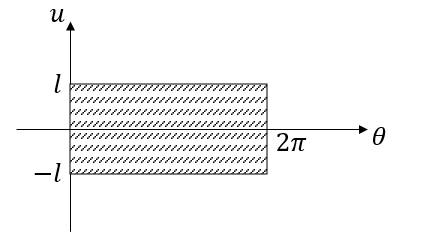
From the expression, we can see that when $\theta$ is $0$ and $2\pi$, the images get glued together.
This method is quite intuitive, but it needs the help of the ambient space $R^3$ (in fact, it uses the fact that the Mobius strip can be embedded into $R^3$).
Method two: the intrinsic method
Let $X=[0,2\pi] \times [-l,l]$. The picture is the same as the $u,\theta$-plane in Method One. The gluing rule is: glue antipodal points together. Next, we construct $M$ using only these two pieces of information.
By this gluing rule, the antipodal points on the left and right sides of the paper strip map two-to-one onto the image: two points become one point. The top and bottom edges of the strip, as well as the interior of the strip, map one-to-one onto the image.
So define an equivalence relation $\sim$ on $X$ by:
- Every point is equivalent to itself.
- Antipodal points are equivalent, namely $(0,u) \sim (2\pi, -u),-l \leq u \leq l$.
This equivalence relation lets us build a quotient set $X/\sim$. Then there is a natural quotient map $\pi: X \rightarrow X/\sim$, sending a point $p$ to $\bar{p}$.
Next, put a topology on $X/\sim$. Define a set in $X/\sim$ to be open if its preimage under the quotient map is open. This is a very simple and blunt definition; it is easy to check that it really is a topology, and it directly gives the continuity of the quotient map (this is the quotient topology). This $X/\sim$ is called a Mobius strip.
Remark: The $X/\sim$ here is actually homeomorphic to the $M$ given in Method One, so the two methods define the same object.
Moduli Space
The set of all lines in $R^2$ passing through the origin is $RP^1$, the one-dimensional real projective space.
Define an equivalence relation $\sim$ as follows: for all $x,y \in R^2 \backslash \lbrace(0,0) \rbrace$, $x$ and $y$ are equivalent if and only if the line $xO$ coincides with the line $yO$. Equivalently, there exists a real number $\lambda$ such that $x=\lambda y$.
Under this equivalence relation, $R^2 \backslash \lbrace(0,0) \rbrace / \sim$ is called a moduli space: a space formed by grouping together elements with a particular structure.
For any line $l \subset R$ in $R^2$ passing through the origin, denote the corresponding point in $RP^1$ by $[l]$. Consider the map $\pi: R^2 \backslash \lbrace(0,0) \rbrace \rightarrow RP^1=R^2\backslash \lbrace(0,0) \rbrace / \sim$, defined by $x \rightarrow [xO]$, where $xO$ is the line through $x$ and the origin.
Next, we give $RP^1$ a topology so that $\pi$ is continuous. We can define it in the same blunt way: a set in $RP^1$ is open if and only if its preimage under $\pi$ is open. One can check that this really is a topology (the quotient topology). Under this topology, $\pi$ is continuous.
Higher-dimensional projective spaces are defined by $RP^n=(R^{n+1}-\lbrace(0,0,...,0)\rbrace)/ \sim$. The equivalence relation is still defined by lying on the same line.
There are several different ways to describe projective space:
- $RP^n \cong S^n/ \sim$, where $\sim$ is the space obtained by gluing antipodal points:
By the definition of $RP^n$, there is a natural projection $\pi : R^{n+1}-\lbrace(0,0,...,0)\rbrace \rightarrow RP^n$, namely the quotient map. Since $S^n$ is a subset of $R^{n+1}-\lbrace(0,0,...,0)\rbrace$, the restriction $\pi |\_{S^n}: S^n \rightarrow RP^n$ is also continuous, and it is obviously surjective (a line always intersects the unit sphere at two points). Also, $S^n$ is compact, and $RP^n$ is clearly a Hausdorff space, so $\pi |\_{S^n}$ must be a gluing map. Since gluing maps are essentially quotient maps, $RP^n \cong S^n / \sim\_{\pi |\_{S^n} }$.
Looking at this equivalence relation $\sim\_{\pi |\_{S^n} }$, it says: $\forall p,q \in S^n$, $p \sim\_{\pi |\_{S^n} } q \Leftrightarrow \pi(p) = \pi(q)$. In other words, $p$ and $q$ are either equal or antipodal.
- $RP^2$ cannot be embedded into $R^3$, but it can be embedded into $R^4$:
Describe $RP^2$ as $S^2/ \sim\_1$, where $\sim\_1$ glues antipodal points of $S^2$ together. Then define a map from $S^2$ to $R^4$:
Under this map, one can check that $f(x,y,z)=f(-x,-y,-z)$, so antipodal points are mapped to the same image. Then $f$ induces the equivalence relation $\sim$, where antipodal points are equivalent, and this equivalence relation further induces a quotient map: $\phi:S^2/ \sim \rightarrow R^4$, where $S^2/ \sim$ is exactly $RP^2$.
First, $\phi$ is clearly continuous. Since there is a natural projection $\pi$ from $S^2$ to $S^2/ \sim$, and $f$ is continuous from $S^2$ to $R^4$, with $f$ equal to $\phi \circ \pi$, $\phi$ must be continuous. As shown in the diagram:
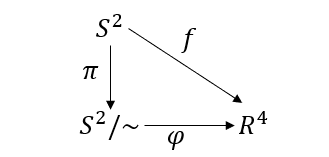
It only remains to show that $\phi$ is an embedding. Since $S^2/ \sim$ is compact and $R^4$ is Hausdorff, as long as $\phi$ is injective, it is an embedding.
As for embedding into $R^3$: all manifolds in $R^3$ are orientable, while $RP^2$ cannot be embedded into $R^3$.
The Mobius strip is the simplest non-orientable manifold. If we glue a disk to the boundary of a Mobius strip, we get $RP^2$, the simplest closed non-orientable manifold.
Klein Bottle
For example, the Mobius strip above can be embedded into $R^3$.
Klein bottle: glue the corresponding edges in the diagram below, with the edges labeled $a$ glued by antipodal points.
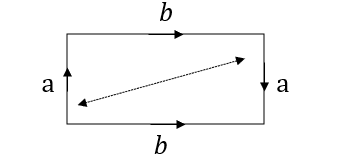
This gluing rule gives an equivalence relation $\sim$, and the quotient space $X/\sim$ under this equivalence relation is defined to be the Klein bottle.
This quotient space cannot be embedded into $R^3$, but it can be embedded into $R^4$.