The ultimate goal of topology:
Classify spaces up to homeomorphism. This immediately leads to two questions:
- Given two spaces, how do we prove they are homeomorphic? This is often rather hard.
- Given two spaces, how do we prove they are not homeomorphic? This is relatively easier.
The effective tools for proving that two spaces are not homeomorphic are topological invariants.
Open Sets/Topologies/Continuity
Open Sets
Let $X$ be a set, and let $\mathscr{F}$ be a family consisting of some subsets of $X$. We call $F$ an open set in $X$ if:
- $X \in \mathscr{F}$, $\varnothing \in \mathscr{F}$.
- If $U, V$ are open sets, then $U \cap V \in \mathscr{F}$.
- If $U\_{\alpha}, \alpha \in I$ are open sets, then $\cup\_{\alpha \in I}U\_{\alpha} \in \mathscr{F}$.
When these conditions are satisfied, we call $X$ a topology, and call $F$ the open sets of this topology. Together, $X$ and $F$ are called a topological space.
Sometimes we simply say that $X$ is a topological space, for example, “let $X$ be a topological space.” What this really means is: let $X$ be a set, and specify which subsets of $X$ are open.
In plain language, the three conditions say: we have the whole set and the empty set, and we allow finite intersections and arbitrary unions.
The corresponding definition of a closed set is the complement of an open set. So closed sets have the dual properties: they include the whole set and the empty set, and allow arbitrary intersections and finite unions.
Examples
Saying $R^n$ is a topological space means, in terms of the definition above, that we take the underlying set to be $R^n$, and take $\mathscr{F}$ to be the usual open sets in $R^n$. That is, a set $U$ is open in $R^n$ if for every point in $U$, there is an open ball containing that point and lying inside $U$.
Trivial topology: let $X$ be a set, and take $\mathscr{F}=\lbrace \varnothing , X \rbrace$.Discrete topology: let $X$ be a set, and take $\mathscr{F}=\lbrace U \vert U \subset X \rbrace$.Take $X=\lbrace 0, 1 \rbrace$, and take $\mathscr{F} = \lbrace \lbrace 0 \rbrace, \lbrace 0,1 \rbrace , \varnothing\rbrace$. Then $\mathscr{F}$ gives a topology on $X$.
Topology induced by a metric space: let $X$ be a set, and suppose a function $d:X \times X \rightarrow R$ is defined on it, satisfying:
- $d(x,y) \geq 0, d(x,y) = 0 \Leftrightarrow x = y$.
- $d(x,y) = d(y, x)$.
- $d(x,y) \leq d(x,z) + d(z,y)$.
Then $X$ is called a metric space. A metric space can induce a topology. First define the open ball in the space:
Then define $U \subset X$ to be an open set if $U$ is empty, or if $\forall p$, $\exists \delta > 0 s.t. p \in B(p;\delta) \subset U$ (the same as in mathematical analysis).
All such $U$ form a topology on $X$ (just verify conditions 1, 2, and 3, exactly as in mathematical analysis). This topology is called the topology induced by the metric.
For example, take $X=C[a,b]$, the set of all continuous functions on $[a,b]$. For all $f,g \in X$, define the distance $d(f,g)=max \vert f(x) - g(x) \vert$. (By the extreme value theorem for continuous functions, this max is always attained.) This metric induces a topology on $X$.
Remark
The same set can be equipped with different topologies. For example, on any set we can define both the trivial topology and the discrete topology.
Whether a set is open depends on the ambient topological space. See Example 2 under subspace topology below.
Subspace Topology
Let $X$ be a topological space, and let $Y \subset X$. Now we want to use the topology on $X$ to induce a topology on the subset $Y$. So we define:
Then $\mathscr{F}$ gives a topology on $Y$. It is called the topology induced by $X$ on $Y$, also called the subspace topology. $X$ is called a topological subspace of $Y$. Note that $U$ ranges over all open sets in $X$.
The statement that $\mathscr{F}$ gives a topology on $Y$ is not a definition; it is something that needs to be proved, directly from the definition of a topological space.
Examples
- Give $R^{n+1}$ the usual Euclidean topology. Take the $n$-sphere:
Then $S^n$ is a subset of $R^{n+1}$, and the usual topology on $R^{n+1}$ induces a subspace topology on $S^n$.
- Consider the interval $[0,1) \subset R$, where $R$ has the usual Euclidean topology. Then $X \subset [0,1)$ is open if and only if $X=U \cap [0,1)$, where $U$ is open in $R$.
For example, the set $[0, \frac{1}{2})$ satisfies $[0, \frac{1}{2}) = (-\frac{1}{2}, \frac{1}{2}) \cap [0, 1)$, and $(-\frac{1}{2}, \frac{1}{2})$ is open in $R$. Therefore $[0, \frac{1}{2})$ is open in the topological subspace $[0,1)$.
So we can see that when we say a set is open, we must specify the corresponding topological space. A set may fail to be open in one topological space, but be open in another.
- Take $Z \subset R$, and give $R$ the usual Euclidean topology. Then $Z$ has the subspace topology. Under this subspace topology, every singleton $\lbrace n\rbrace$ is open, because $\lbrace n \rbrace=(n-0.5,n+0.5) \cap Z$. In other words, the subspace topology on $Z$ is equivalent to the discrete topology on $Z$.
Limit Points
Limit point (accumulation point): let $X$ be a topological space, and let $A \subset X$. For $\forall p \in X$, we call $p$ a limit point in $X$ if for every open set $U$ containing $p$, we have $(U\backslash \lbrace p\rbrace) \cap A \neq \varnothing$. In other words, even after removing $p$ from $U$, there are still points of $A$ left in it.
Closure: $\bar{A} = A \cup \lbrace \text{all limit points of } A \rbrace$.
$A$ is closed $\Leftrightarrow \bar{A} = A$. The equality $A = \bar{A}$ means both $A \subset \bar{A}$ and $\bar{A} \subset A$; the first is obvious from the definition. The second says that every limit point of $A$ is still in $A$.
Necessity: suppose $A$ is closed. To prove $A = \bar{A}$, it is enough to prove $\bar{A} \subset A$, equivalently $X \backslash A \subset X \backslash \bar{A}$. That is, for every $p \notin A$, $p$ is not a limit point of $A$. Since $A$ is closed, $X \backslash A$ is open, so there exists $U \subset X \backslash A$ with $p \in U$. Since $(U \backslash \lbrace p \rbrace) \cap A = \varnothing$, $p$ is not a limit point of $A$.
Sufficiency: suppose $A = \bar{A}$. We prove that $A$ is closed. It is enough to prove that $X \backslash A$ is open. For every $p \in X \backslash A$, we need to show that there is an open set $U$ such that $p \in U \subset X \backslash A$.
Since $p \notin A$, we also have $p \notin \bar{A}$. Therefore $p$ is not a limit point of $A$, so there exists an open set $U$, $p \in U \subset X$, such that $(U \backslash \lbrace p\rbrace) \cap A = \varnothing$. Since $p \notin A$, we get $U \cap A = \varnothing$, that is, $p \in U \subset X \backslash A$.
Corollary: The closure is always closed, and the closure $\bar{A}$ of $A$ is the smallest closed set containing $A$.
Properties: 1. $\bar{A \cup B} = \bar{A} \cup \bar{B}$. 2. $\bar{A \cap B} \subset \bar{A} \cup \bar{B}$
In mathematical analysis, an equivalent definition is that $p$ is a limit point of $A$ if and only if there exists a sequence of points $\lbrace x\_n\rbrace$ in $A$ such that $\lim\_{n\to+\infty}x\_n = p$. In a general topological space, however, we have not defined what a limit is.
Examples
- Take $X=\lbrace 0, 1 \rbrace$, and take $\mathscr{F} = \lbrace \lbrace 0 \rbrace, \lbrace 0,1 \rbrace , \varnothing\rbrace$. Then $\mathscr{F}$ gives a topology on $X$.
Take $A=\lbrace 0\rbrace$, and look at the limit points of $A$.
$0$: since $A$ is a singleton, removing $0$ leaves the empty set, so $0$ is not a limit point of $A$.
$1$: every open set $U$ containing $\lbrace 1\rbrace$ can only be $\lbrace 0,1 \rbrace$. Then $(U \backslash \lbrace 1\rbrace) \cap A = \lbrace 0\rbrace$, so $1$ is a limit point of $A$.
Take $A=\lbrace 1\rbrace$, and look at the limit points of $A$.
$0$: take $U=\lbrace 0\rbrace$, an open set containing $0$. Removing $0$ leaves the empty set, so $0$ is not a limit point of $A$.
$1$: the only open set containing $1$ is $U=\lbrace 0,1\rbrace$. After removing $1$, $(U \backslash \lbrace 1\rbrace) \cap A = \varnothing$, so $1$ is also not a limit point of $A$.
Dense Sets/Interior Points/Exterior Points/Boundary Points
Definition: let $X$ be a topological space. A subset $A \subset X$ is called dense in $X$ if $\bar{A} = X$. Equivalently, one can say that for any point $x \in A$, and any open set containing $x$, after removing $x$ this open set still has nonempty intersection with $A$.
Let $X$ be a topological space, let $F \subset X$ be a dense set, and take $U \subset X$. The set $F \cap U$ is not necessarily dense in $U$. For example, let $U=X \backslash F$, and the intersection is empty. But if $U$ is open, then $F \cap U$ is dense in $U$.
Interior points: $int(A) := \lbrace p \in A \vert \exists open \,set \, V \subset X , s.t. \, p \in V \subset A \rbrace$.
Exterior points: $int(A) := \lbrace p \in A \vert \exists open \,set \, V \subset X , s.t. \, p \in V \subset X \backslash A \rbrace$.
Boundary points: $\partial(A) := \lbrace p \in X \vert \forall open \, set \, V, V \cap A \neq \varnothing, V \cap (X \backslash A) \neq \varnothing \rbrace$.
The points of a topological space can be decomposed into the disjoint union of the three sets above.
Examples
- For the rational numbers $Q \subset R$, we have $\bar{Q} = R$. The rational numbers are dense.
To prove that the rational numbers are dense in the real numbers, it is enough to show that their closure under the standard topology is the whole real line. Since $R$ has a metric structure, its subsets naturally become metric spaces, so their closures can be constructed by adjoining the limits of all Cauchy sequences in the set. So the problem is equivalent to: $Q$ is dense in $R$ $\Leftrightarrow$ every irrational number can be represented as the limit of some Cauchy sequence (according to Cantor’s definition of real numbers, irrational numbers are precisely limits of rational Cauchy sequences).
Cauchy sequence: this definition depends on a metric and only exists in metric spaces. Given a sequence $\lbrace x\_1, x\_2, ...\rbrace$ in a set $X$, we call it a Cauchy sequence if $\forall r > 0$, $r \in R$, $\exists N \in N^+$ such that for all positive integers $m,n>N$, we have $d(x\_m, x\_n)<r$.
Complete metric space: a metric space in which every Cauchy sequence converges. Any metric space can be completed; just add in the limits of all Cauchy sequences. For example, on $Z$, define the metric:
Then the sequence ${1, 2, 3, ...}$ is Cauchy but divergent. If we add positive and negative infinity to the space, it can be completed, and the sequence converges to infinity.
Topological Bases
Let $X$ be a topological space, and let $\mathscr{B}$ be a family of open sets in $X$. We say $\mathscr{B}$ forms a topological basis for $X$ if every open set $U$ in $X$ can be written as a union of some elements of $\mathscr{B}$.
$\mathscr{B}$ is a topological basis for some topology $\mathscr{F}$ on $X$ if and only if:
- $\cup\_{U \in \mathscr{B} } U = X$.
- $\forall U\_1, U\_2 \in B, U\_1 \cap U\_2$ can be written as a union of some elements of $\mathscr{B}$. (Equivalent description: $\forall U\_1, U\_2 \in B, \forall p \in U\_2 \cap U\_2, \exists U\_3 \in \mathscr{B}, s.t. \, p \in U\_3 \subset U\_2 \cap U\_2$)
$\mathscr{F}$ is called the topology generated by $\mathscr{B}$.
Necessity: obvious.
Sufficiency: define $\mathscr{F}$ as the set of unions of elements of $\mathscr{B}$.
We need to prove that $\mathscr{F}$ is a topology, and that $\mathscr{B}$ is a topological basis for this topology.
- Verify that $\mathscr{F}$ is a topology. The empty set is immediate. The whole set is also fine because condition 1 gives $\cup\_{U \in \mathscr{B} } U = X$. Arbitrary unions are fine because elements of $\mathscr{F}$ are already unions of elements of $\mathscr{B}$; taking another union is still just a union of elements of $\mathscr{B}$. Finite intersections follow from condition 2. For finite intersections, take $\forall \cup\_{\alpha \in I}U\_{\alpha},\cup\_{\beta \in I}V\_{\beta} \, \in \mathscr{F}$, where $U\_{\alpha}$, $V\_{\beta} \in \mathscr{B}$, and $I$ and $J$ are index sets. We have
By condition 2, the right-hand side still belongs to $\mathscr{F}$.
- To show that $\mathscr{B}$ is a topological basis for this topology, we need two things. First, every element of $\mathscr{B}$ is open, which is clear. Second, every element of $\mathscr{F}$ can be written as a union of elements of $\mathscr{B}$, which is exactly how $\mathscr{F}$ was defined.
The picture for the equivalent description of condition 2 is:
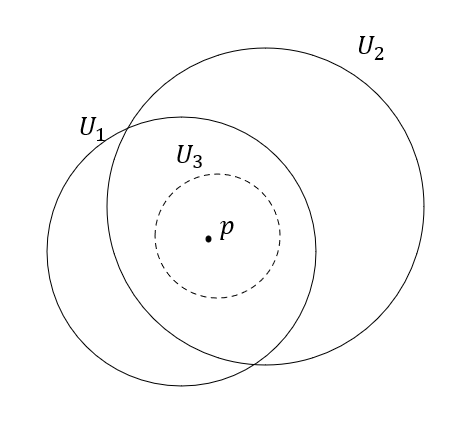
Condition 2 $\Rightarrow$ equivalent description: since $U\_1 \cap U\_2$ can be expressed using $\mathscr{B}$, $p$ must belong to one of those sets. Choose that set as $U\_3$.
Equivalent description $\Rightarrow$ condition 2: in fact, $U\_1 \cap U\_2$ is exactly $\cup\_{p \in U\_1 \cap U\_2}U\_3$.
The next question is: if $\mathscr{B}$ and $\mathscr{B}^{\prime}$ are both topological bases, when do they generate the same topology?
Definition: let $\mathscr{B}$ and $\mathscr{B}^{\prime}$ both be topological bases. We call them equivalent if: (each one can be found inside the other)
- For every $U \subset \mathscr{B}$ and $p \in U$, there exists $U^{\prime} \in \mathscr{B}^{\prime}$ such that $p \in U^{\prime} \subset U$.
- For every $U^{\prime} \subset \mathscr{B}^{\prime}$ and $p^{\prime} \in U^{\prime}$, there exists $U \in \mathscr{B}$ such that $p^{\prime} \in U \subset U^{\prime}$.
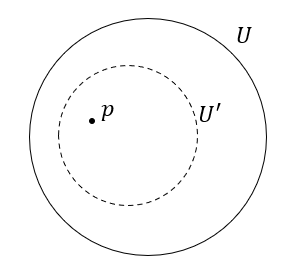
Thus, if $\mathscr{B}$ and $\mathscr{B}^{\prime}$ are both topological bases and they are equivalent, then the topology $\mathscr{F}$ generated by $\mathscr{B}$ and the topology $\mathscr{F}^{\prime}$ generated by $\mathscr{B}^{\prime}$ are the same.
$\forall U \in \mathscr{F} \Rightarrow U = \cup\_{\alpha}U\_{\alpha}, \quad U\_{\alpha} \in \mathscr{B}$. For each $U\_{\alpha}$, by the definition of equivalence, for every $p \in U\_{\alpha}$, there exists $V\_p \in \mathscr{B}^{\prime}$ such that $p \in V\_p \subset U\_{\alpha}$. Therefore $U\_{\alpha}=\cup\_{p \in U\_{alpha} }V\_p \in \mathscr{F}^{\prime}$. Hence $U=\cup\_{\alpha}U\_{\alpha} \in \mathscr{F}^{\prime}$. So $\mathscr{F} \subset \mathscr{F}^{\prime}$. Similarly, one can prove $\mathscr{F}^{\prime} \subset \mathscr{F}$, and therefore $\mathscr{F}^{\prime} = \mathscr{F}$.
Examples
- In $R^2$, take:
Verify that $\mathscr{B}^{\prime}$ is a topological basis. First, the union of all sets in $\mathscr{B}^{\prime}$ is clearly $R^2$, so the first condition for a topological basis is satisfied. For the second condition, the intersection of any two rectangles is still a rectangle, and is still in $\mathscr{B}^{\prime}$. Therefore $\mathscr{B}^{\prime}$ is a topological basis for some topology on $R^2$.
In $R^2$, the original definition gives a basis $\mathscr{B}$ consisting of open balls. It is easy to check that $\mathscr{B}$ and $\mathscr{B}^{\prime}$ are equivalent, so the topologies $\mathscr{F}$ and $\mathscr{F}^{\prime}$ they generate are the same topology. Both are the Euclidean topology.
- Let $A$ be a commutative ring, and let $a \subset A$ be an ideal of $A$. Then $a \supset a^2 \supset a^3 \supset ...$. Define:
Verify that $\mathscr{B}$ is a topological basis:
- Since $x$ ranges over all of $A$, the union of all elements of $\mathscr{B}$ is naturally $A$.
- For any $x+a^n, y+a^m \in \mathscr{B}$, assume without loss of generality that $n>m$. For every $z \in (x+a^n) \cap (y+a^m)$, consider $z+a^n$. Since $z \in A$, we have $z \in x+a^n$. Since $z \in y+a^m$, we have $z+a^n \in y + a^n + a^m \subset y + a^m$. Therefore: $z \in z+a^n \subset (x+a^n) \cap (y+a^m)$. By the equivalent description of condition 2 for topological bases, this also works.
Therefore $\mathscr{B}$ generates a topology, called the ideal $a$-topology.