Topology 05 - Homogeneous Coordinates and Projective Geometry

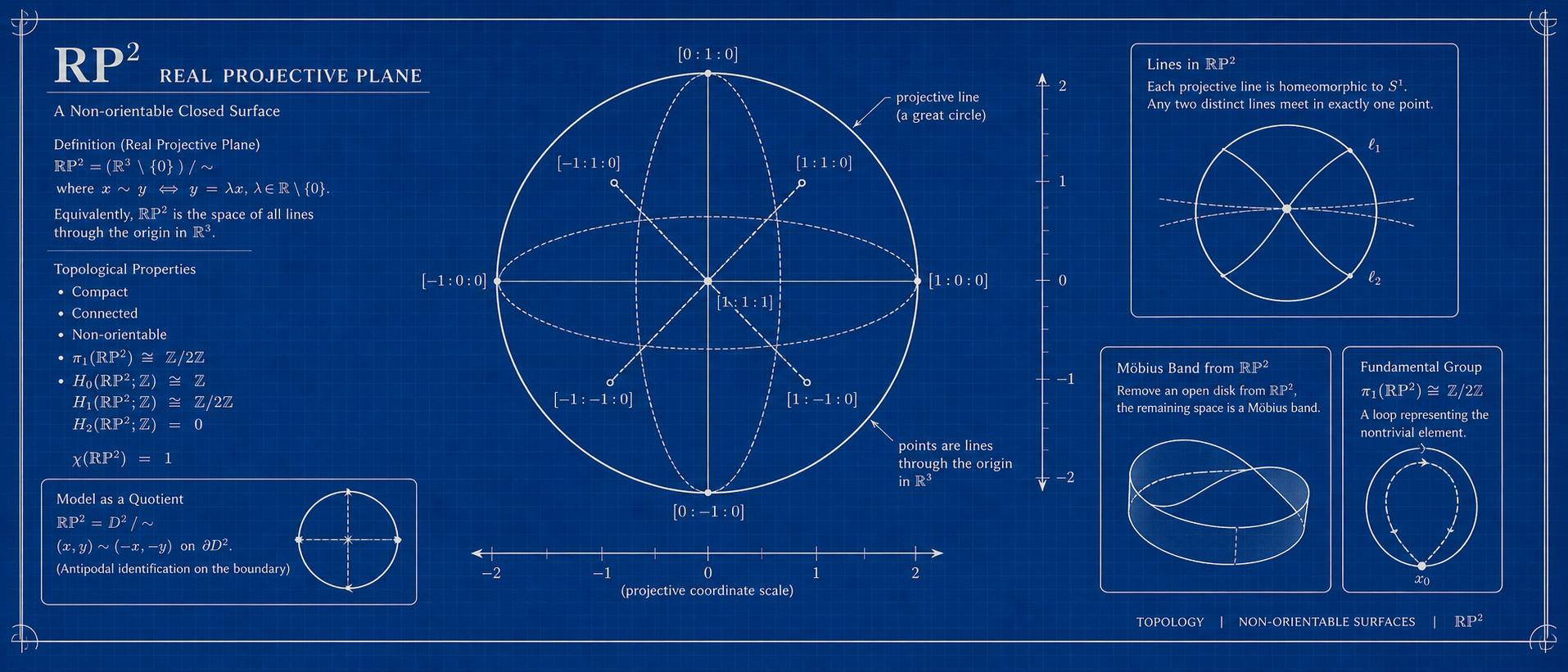
Homogeneous Coordinates and Projective Geometry If you work in computer graphics, you deal with the following operations every day: A point in 3D space is written as a 4D vector $(x,y,z,w)$. $(x,y,z,w)$ and $(kx,ky,kz,kw)\;(k \neq 0)$ represent the same point. At render time, you perform a “perspective divide”: $(x/w,\;y/w,\;z/w)$. $w=0$ is treated as a “direction”—a point at infinity. This design is not a graphics programmer’s invention. Its roots lie in 19th-century projective geometry. Homogeneous coordinates are not an engineering hack; they are the most natural coordinate system for projective space. ...
2021-09-05 · 17 min · 3539 words · BlueHour

Topology 04 - Quaternions

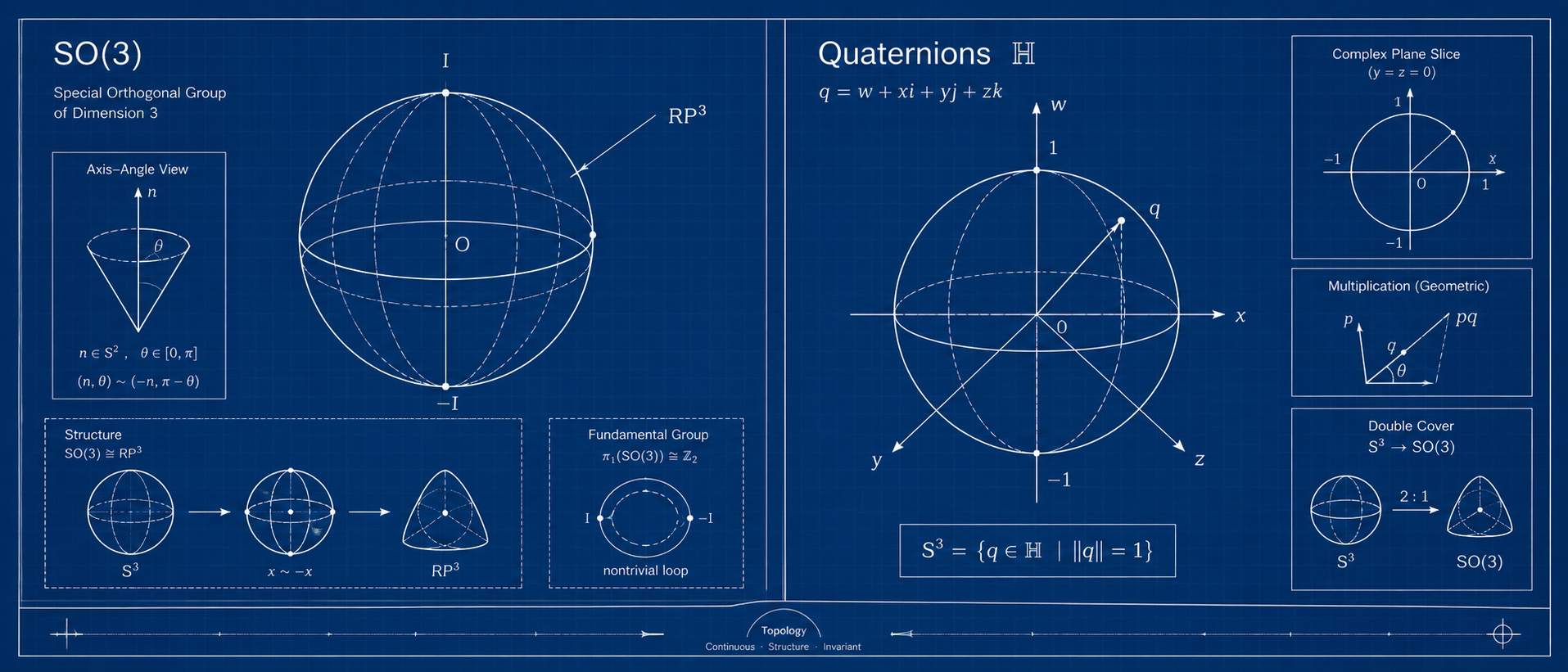
Quaternions Algebraic Definition Let $\mathbb{H}=\lbrace a+bi+cj+dk \mid a,b,c,d \in \mathbb{R}\rbrace$. There is a vector-space structure on $\mathbb{H}$: $$ \cdot: \mathbb{R} \times \mathbb{H} \rightarrow \mathbb{H}: (\lambda, a+bi+cj+dk) \rightarrow (\lambda, \lambda a+\lambda bi+\lambda cj+\lambda dk) $$ $$ \begin{aligned} +:\mathbb{H} \times \mathbb{H} \rightarrow \mathbb{H}: (a_1+b_1i+c_1j+d_1k, a_2+b_2i+c_2j+d_2k) \\ \rightarrow (a_1+a_2, (b_1+b_2)i,(c_1+c_2)j,(d_1+d_2)k) \end{aligned} $$ Clearly $(\mathbb{H},+)$ is an abelian group, so $(\mathbb{H},+,\cdot)$ is an $\mathbb{R}$-linear space. In addition, we define a multiplication operation on $\mathbb{H}$. First set: $$ i^2=j^2=k^2=ijk=-1 $$ $$ ij=k,jk=i,ki=j,ji=-k,kj=-i,ik=-j $$ Then multiplication is defined componentwise. To keep the notation lighter, the imaginary part can be written as a vector: $\vec{v}=(b,c,d)$. A quaternion can then be written as $x=[a,\vec{v}]=a+\vec{v}$; this is only notation, and does not mean we are adding a scalar and a vector. ...

2021-08-30 · 8 min · 1678 words · BlueHour

Topology 03 - Quotient Sets

Quotients Quotient Sets Let $X$ be a set. An equivalence relation on $X$ is a relation that is reflexive, symmetric, and transitive. Let $X$ be a set, and let $\sim$ be an equivalence relation on $X$. For any $a \in X$, the set $\bar{a} =\lbrace b \in X | b \sim a \rbrace$ is the equivalence class containing $a$. An equivalence class is a special kind of subset: if two equivalence classes intersect, then they must actually be the same class (by transitivity). ...

2021-08-21 · 9 min · 1908 words · BlueHour

Topology 02 - Continuity, Compactness, and Connectedness

Continuity/Compactness/Connectedness The Definition of Continuity In mathematical analysis, we define continuity of a function like this: $f$ is continuous at $x\_0$ if for every $\epsilon$, there exists a $\delta$ such that for every $x \in R^n$, if $\vert \vert x - x\_0 \vert \vert < \delta$, then $\vert \vert f(x) - f(x\_0) \vert \vert < \epsilon$. And we define an open set in $R^n$ as follows: $U \subset R^n$ is called an open set in $R^n$ if for every $x \in U$, there exists a $\delta$ such that $B(x;\delta) \subset U$, where $B(x;\delta)$ is an open ball. ...

2021-08-10 · 23 min · 4739 words · BlueHour

Topology 01 - Open Sets, Topologies, and Limit Points

The ultimate goal of topology: Classify spaces up to homeomorphism. This immediately leads to two questions: Given two spaces, how do we prove they are homeomorphic? This is often rather hard. Given two spaces, how do we prove they are not homeomorphic? This is relatively easier. The effective tools for proving that two spaces are not homeomorphic are topological invariants. Open Sets/Topologies/Continuity Open Sets Let $X$ be a set, and let $\mathscr{F}$ be a family consisting of some subsets of $X$. We call $F$ an open set in $X$ if: ...

2021-08-01 · 13 min · 2716 words · BlueHour